Showing posts with label nature. Show all posts

Thursday, June 30, 2011

The Lore of Dragons & Damsels

This was the final week of our Pond study.  To cap everything off we learned about dragonflies and damselflies.  How are they similar? How are they different?  I never knew to even wonder before, but now that I've had to study up on them for this - they are actually fairly fascinating.  I learned so much more than I think I even taught the girls!
Learn to make this dragonfly at the bottom of the post.

Day 1: The Dragonfly
We learned all about the dragonfly today.  Here are some of the fun facts that we learned:
  • Dragonflies are carnivorous - they eat other insects like mosquitoes.
  • Dragonflies lay eggs in or around calm waters (like ponds!)  The eggs hatch into baby dragonfly larvae called nymphs.  Nymphs do not have wings, they live in the water.  As the nymph grows it sheds it skin.  When the nymph is ready to become a dragonfly it will crawl out of the water and shed its skin one last time, emerging as a dragonfly with wings.  The whole process can take anywhere from a few weeks to four years depending on the type of dragonfly.
  • Dragonflies have 6 legs, 4 wings, and 3 body segments.
  • Dragonflies have 2 sets of wings that are dissimilar in shape.
  • Dragonflies usually keep their wings either held out away from their bodies horizontally.
  • Dragonfly eyes are set high on their head and close together, almost touching.
  • Dragonflies have a stocky body.
  • Dragonflies are very poor walkers, they use their legs for landing, not walking.  They fly everywhere.
 We did art time with dragonflies - Abby drew a very cute set of dragonflies.  I showed her step by step how to draw one and she did fairly well.


Day 2: The Damselfly
Today we learned about the damselfly.  The damselfly and dragonfly are very similar.  Here is some facts about the damselfly:
  • Damselflies are carnivorous - they eat other insects like mosquitoes.
  • Damselflies lay eggs in or around calm waters (like ponds!)  The eggs hatch into baby damselfly larvae called nymphs.  Nymphs do not have wings, they live in the water.  As the nymph grows it sheds it skin.  When the nymph is ready to become a damselfly it will crawl out of the water and shed its skin one last time, emerging as a damselfly with wings.  The whole process can take anywhere from a few weeks to years depending on the type of damselfly.
  • Damselflies have 6 legs, 4 wings, and 3 body segments.
  • Damselflies have 2 sets of wings that are similar in shape.
  • Damselflies usually keep their wings held together and parallel to their body.
  • Damselfly eyes are set on either side of their head and far apart.
  • Damselflies have a very thin long body.
  • Damselflies are very poor walkers, they use their legs for landing, not walking.  They fly everywhere.
Today we did some art practice with damselflies.  Since we did dragonflies yesterday I emphasized the differences in the damsel and dragonflies.

Day 3: Difference between a damsel and a dragon
Although the dragonfly and damselfly may appear very similar, and have a lot of similarities, they also have many differences and are easily distinguished from one another.  Here is how you differentiate a dragonfly from a damselfly:
  • The larvae of each appears similar, however the damselfly larvae are much more slender and have 3 gills at the posterior instead of 2 like a dragonfly nymph.
  • The damselfly body is much more slender than a dragonfly.
  • The back wings of a dragonfly are shaped differently than the front wings, on a damselfly all 4 wings appear the same.
  • A dragonfly holds its wings out horizontal when at rest, but a damselfly will hold the wings together over its back instead.
  • The eyes of a dragonfly are on top of its head nearly touching, damselfly eyes are farther apart near the sides of their head.
We did a very fun craft for the last day of Pond month.  This might be a bit messy for you, but it was really neat (at least to me) and the girls loved it too. It is also a great way to get rid of any broken crayons in your house without wasting them!

Make Your Own Dragonfly

What you will need for the craft:
  • A towel (it may get wax on it, so make it one you don't like)
  •  Wax paper
  • broken crayons in different colors
  • small plate or bowel(s)
  • scissors
  • iron
  • pipe cleaner (1/2 per dragonfly)
  • fuzz ball (x1 per dragonfly)
  • google eyes (x2 per dragonfly)
  • glue
If you want to prep for the craft you should use the scissors to scrape off flakes of wax from the broken crayons onto the plate or into a bowl.  You can use a different bowl/plate for each color if you want to make things go quickly, or one for less mess.  Keeping the colors separate will make the end product more colorful (less brown or gray).  Also set the towel down on a flat surface and flatten it out as much as possible.
Cut a strip of wax paper (about 3-4 inches long and the whole width of the roll wide), fold it in 1/2 and set it down on the towel.  Sprinkle the wax paper with the colored wax shavings in any pattern you like.  Try not to make the shavings too thick in any one part.

Once you have created the desired design with the shavings, fold the other half of the wax paper over it.
Cover with the other 1/2 of the towel or a second towel.  Again, try to keep the towel as flat as possible.
Set the iron to low or medium (do not use high or you might overcook the dragonfly).
Iron over the towel for a minute (or until you can peek underneath and it appears fully melted together).  Allow the wax to cool for several minutes.
Next you draw a pair of dragonfly wings over the wax wherever it appears the "prettiest," then cut them out.
I used only 1/2 a pipe cleaner, but if you make a larger set of wings you can use a whole pipe cleaner.
 Fold the pipe cleaner in 1/2 and slide the wings into the pipe cleaner all the way up to where it is bent, then twist it to secure the wings in place.
 Continue to twist the the pipe cleaner to the end, but leave the two ends poking out (to mimic a real dragonfly).
 Put a generous drop of glue at the top of the pipe cleaner.
 Press down the fuzz ball and hold it for several seconds to make sure it will stay in place.
 Add 2 small drops of glue to the top of the fuzz ball.  Be careful not to move the fuzz ball out of place, it will take a while for the whole thing to dry.  If it does fall off, just add more glue and put it back in place. ;)
 Add the google eyes on the top of the fuzz ball.
 And wallah!  You have totally cute dragonflies!


 They might have turned out a little cuter if I'd had smaller fuzzballs, or bigger wings?  But these were SO ADORABLE!  I love them.
 So here is our finished pond window collage.  I'm going to let it remain up the rest of this week, then next week we'll move on to a different habitat. 

In other news, Abbagail is learning about dimes now, and thus counting by 10's.  She loves doing real life math - I make these sheets for her with different objects that cost different amounts, then make her budget her money to accomplish a task.  Today's was making lunch for everyone.  She had to pick which bread, peanut butter, jelly, drinks, and fruit to get everyone.  I threw her a few curve balls today by telling her that some of the bread and jelly some people don't like, and that each person wanted a different kind of fruit.  Then Mommy and daddy needed lunch on top of her and her sisters, so she had to "re-shop" for more drinks and fruit.  Then we counted her change.  Fun stuff.

I printed out another month of math for Tahlia and Serenity too - they are reviewing 1-5 and learning 6-10.  Serenity already knows them fairly well, but this is Tahlia's first time through.  Fun stuff!  They are also learning Letter C this week.  I'm amazed at how well Tahlia is doing for her first time through the alphabet.  This is Serenity's 2nd time through, so she is able to do all the work fairly easily because she already recognizes the letters and mainly is working on just the sounds and writing practice.  Their work is so fast and easy.

The mail has been awesome too.  All the mail we hadn't gotten for 2 wks has been arriving and Abbagail has been ecstatic about her gifts!  I'm always so amazed that everyone gets such great stuff for my kids.  I can never figure out what kids really like (even my own!) but everyone else seems to get just the right thing.  I'm so clueless.  Sigh... To each his own I guess - can't be good at everything.
Special hugs and love to everyone who sent her cards and gifts - thank you for making my baby so happy!  You blessed me even more than her, it really has made this month wonderful watching the joy you all brought to her (and her sisters too!)

Saturday, June 25, 2011

Lots of Other Fish in the Pond

So this week we continue learning about our Pond habitat by learning about the fish that live in the pond. 


Day 1: Like always this day was packed full of introducing information.  I read lots of books to the girls about fish and we learned what makes a fish, a fish!  Here are some of the cool facts we learned about fish:
  • Fish have backbones
  • Some fish have hard bones like people, other fish have soft bendy bones made of cartilage (same stuff that makes up our ears).
  • Fish have a head, body, and tail. They also have eyes and gills on the head, scales all over their body, and fins on their backs, tummy, sides, and tail.
  • Fish swim with their fins
  • Fish breathe with their gills by sucking in water through their mouth, then closing their mouth and pushing the water out through the gills.  The gills take oxygen out of the water so the fish can breathe.
  • Scales are like tiny little overlapping plates that keep the fish safe, they can come in lots of colors and can be smooth or rough, big or small.
  • Some fish have spines on them to help protect them too.  When they are scared, they stick out the spines to poke predators (predators are animals that eat other animals).
  • Fish are cold blooded, which means they are the same temperature as their environment.  If you take a fish out of his home water and stick him in new water that is a different temperature, it hurts the fish, just like if someone were to put us in ice or boiling water.  We discussed the proper way to transfer fish from one tank to another - or when cleaning the tank how to re-introduce the fish to the water by placing it in a baggie with its old water and setting the whole thing in the new tank for several hrs so the fish becomes the same temperature gradually over time.
  • Fish are omnivorous, they eat plants, bugs, and even other smaller fish or animals.
  • Lots of people like to go fishing and catch fish to eat - they taste yummy and are good for us.  They help us grow up big and strong.  Fish are a part of the meat group.
I'm sure we learned other things, but those are the main facts that we learned this week about fish.


Day 2:  Since I got a cold from a small child at Safeway on Saturday (yep, I know it was this kid because she was EXPLODING with boogies and I was stuck behind her and her mom waiting to get Abby's b-day cake), we were a bit mellow this week too.  Today we did some fish drawing.  I've been finding some things online that are step by step drawing instructions, and I think the concept is still too advanced for Serenity or Tahlia, but Abbagail did some very cute fish.
Here is one fish colored, one not colored. They were striped fish.
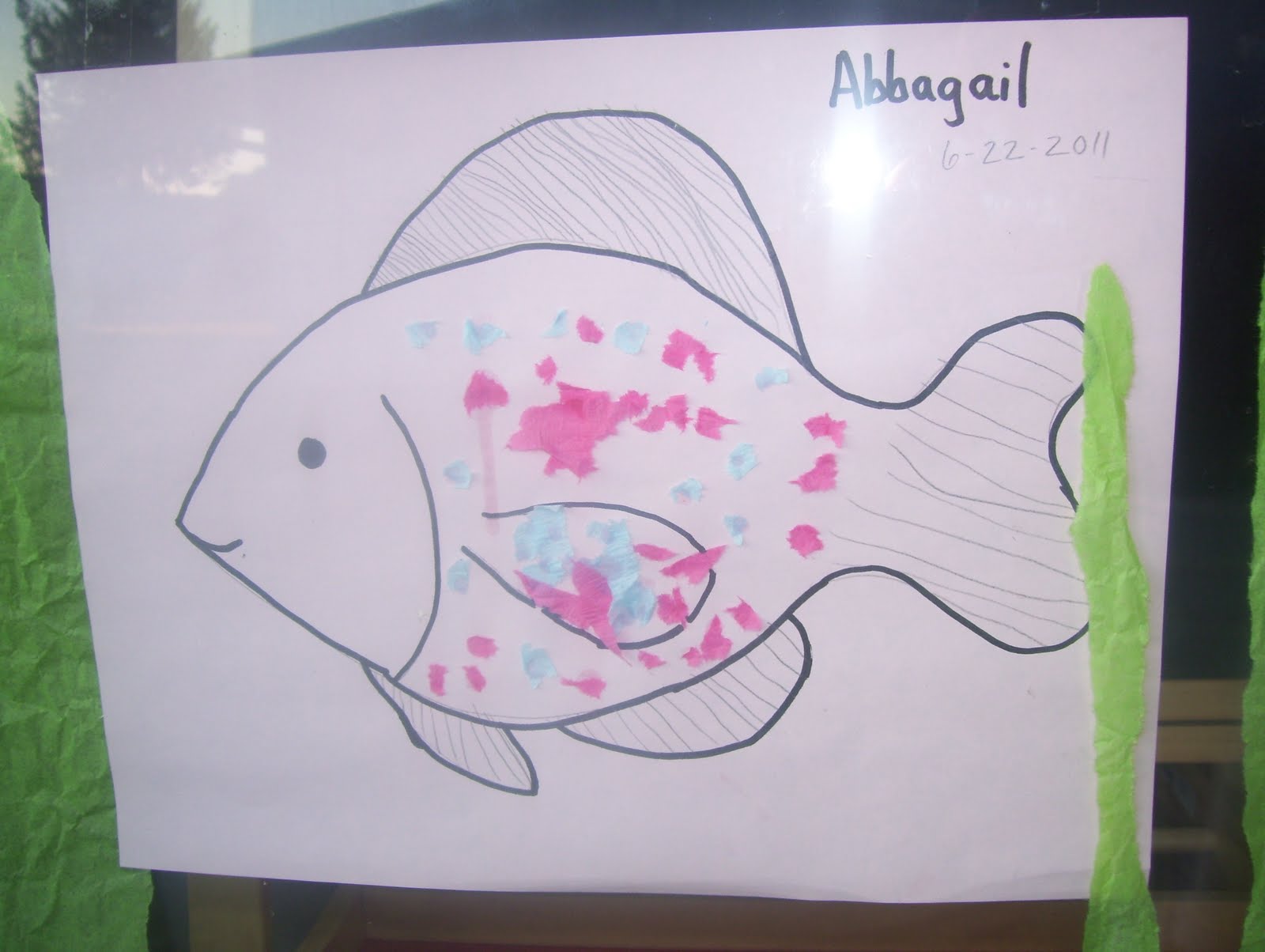
Day 3: I wanted all the girls to get into the science thing again (Abby has been monopolizing most of it) so we did fish collages today with tissue paper.  I also put up all the art they have been doing in the front window in an attempt to get them more energized about what they are learning - nothing like a little showing off to all their friends to get them not only talking about what they learned, but I caught them teaching their friends about the animals too!  I didn't even think it would do more than look cute, but they get to talk about what is in the window with others and it helps them recall the info I'm teaching and put it into their own words.  Totally awesome idea that I didn't even mean to be so awesome! Yay me!
Serenity really liked making the collage. I think because I sat and helped tear the paper.

Tahlia kept telling me "I can't do it!" Looks pretty done to me kid!

Abbagail wanted to make her scales herself, she said they were supposed to be smaller. She is not afraid of intricate and tedious tasks - just like mommy.
This is our front window pond.  I used some brown paper for mud at the bottom (you can't see it here) and green tissue paper for the water plants.  The very top is Abbagail's duck picture, the frog collages are below that, and the new fish collages are swimming down in the water. We'll add more when we learn bugs next week and hopefully I'll get a pic before we switch it out for July.
 Day 4: We had our test today and labeled fish pictures with the basic parts.  I also asked them questions about fish to make sure they got something out of our week.  Overall it was a fun relaxed day.

This week was long, but we only did fish every other day.  Mostly I had just enough energy for math and reading for everyone and a simple art project.  Hopefully the weekend will help me recover - I'm taking Sat and Sun off from schooling at all or working at all even (all the chores will be there Monday I'm sure!)  If I don't get over the cold I wont be able to finish bug week before July 1st!

A few of the other fun things we got to do this week were: the splash park, playing outside in some nice sunny weather (for a change!), 2 trips to the library, and lots of "The Little Mermaid" and "Finding Nemo"!  (They also watched "Ponyo," but not many of you will know that one - it is cute though).  I couldn't find any fish songs to sing... and I wasn't feeling up to the internet searches for video clips of real fish, but oh well.  We had one really windy day on which I attempted to make a home made kite... but although it would fly briefly, it wasn't stable (kept spinning) and I couldn't fix that... but the girls were excited for a full hour watching me try to get it to work and taking turns having it lift off and spin around before crashing back to the earth.

there is a neat army car for the kids to play with at the playground


Abbagail is the only one who will go in the water 


Serenity enjoys being wherever I am


Abby is learning more about money in math right now, she can count pennies and write them as cents (with the cent sign and everything) she can say how many cents things are, add the cents, and even recognize what she can buy with a certain number of pennies.  This coming week we'll introduce nickels and keep her moving on.  Our calendar is working great - she now puts her full name and date on all her homework by herself. Yay!  She kept wanting to write her middle name too, but it wont fit so I convinced her it was overkill.


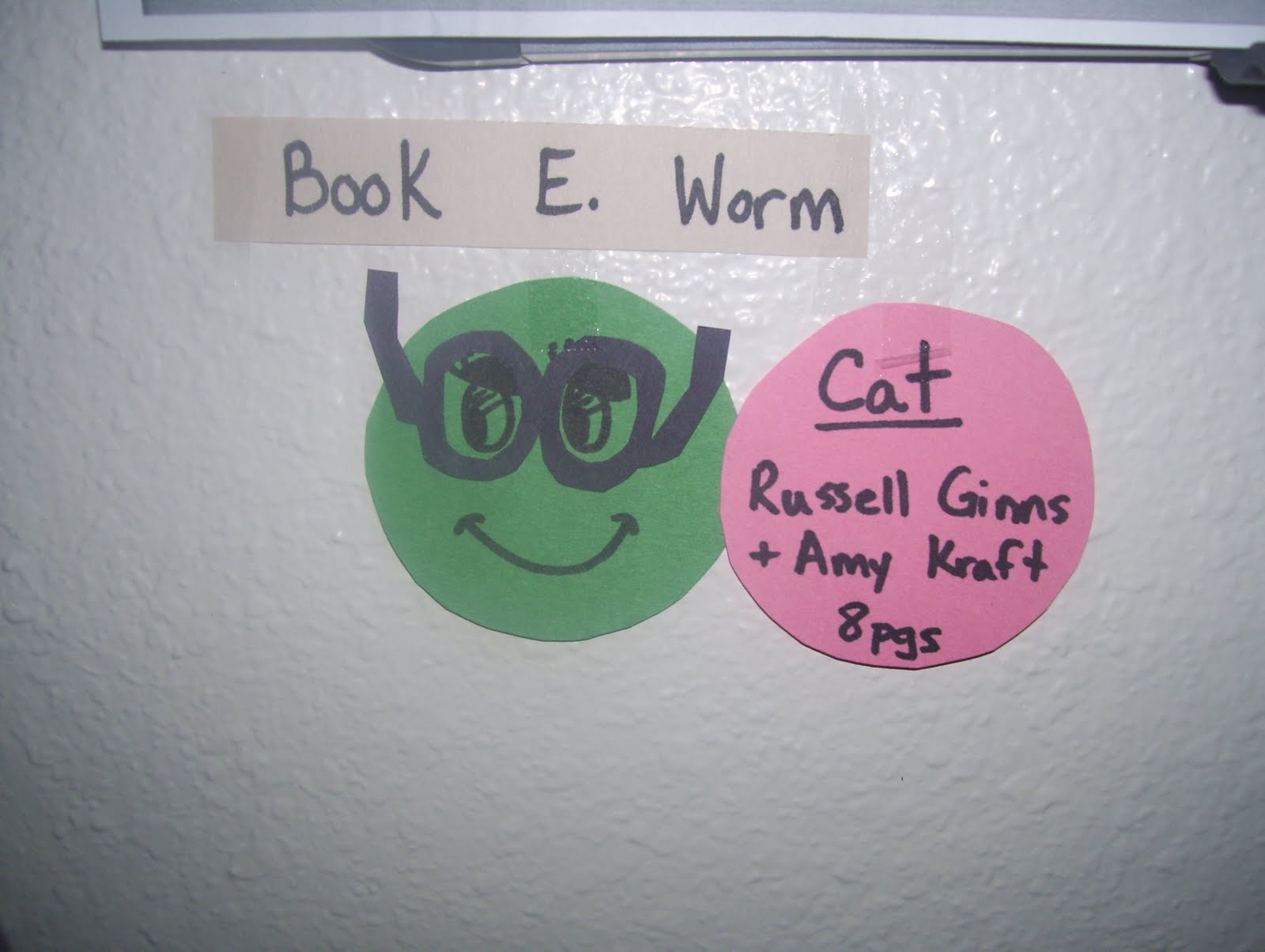
We started a "Book E. Worm" - he's a little pea head who loves to eat books.  Abby is going to feed him all the books she reads (has to read it without any mistakes) and earn prizes for every time she gets to a green body part. (that will be every 8th book).  I got myself a little treasure chest with small prizes like pencils, erasers, stickers, notepads, coloring pages, markers, tattoos, etc. in it.  Things that are a dime a dozen and the girls love to play with. I should go buy a sheet of bubble wrap and cut it up - they love that stuff!!!  I might end up having to make it more books per prize though - I think she's going to get like 4-5 books done on Monday alone!
Abbagail thinks it's hilarious to call him a "little pea head."
That's everything new for now.  I have a lot more that I want to do with the girls this coming week.  Our school is really evolving as we get into more subjects now that the girls are getting older.  I have so much stuff that they know so well I don't even need anymore - like all my "learning colors" books and printables.  Oh well, they are fun to use with Tahlia, they keep her occupied with something easy when I need more time to devote to everyone else.

Saturday, June 11, 2011

Pond Month: Duck, Duck, Goose!

This week we are learning about ducks and geese (and I threw in a few other water birds just for comparison too).

Day 1: Ducks
We watched some videos on ducks so the girls got a good look at what different ducks look like.  Arkive.com is a great website with lots of videos of animals in the wild.  They are not documentary type videos (i.e. no one is talking or telling you anything about the animals), but they are very good for showing how an animal acts in its natural environment.  We also watched some silly videos like the "Duck Song" - it's on youtube.com, there are 3 of them in total and they are kind of cute little joke songs about a duck.  My eldest was singing them ALL DAY - so be prepared, the song is catchy.  We also had fun waddling around like ducks to the songs - tuckered them out real good so they were prepped to sit down a bit and listen during story time!

After the videos we read "Ducks Don't Get Wet" by Augusta Goldin.  It tells a bit about ducks and centers mainly around how ducks preen themselves so that their feathers will be waterproof.  I added a few tidbits of information on ducks as we read, then we did our science time!
This is a close-up of Abby's feather repelling the water.

This science experiment was so much fun!  To do it you'll need:
  • paper (colored or white is fine, we used a paper bag)
  • scissors
  • about 1/4 cup oil in a small dish/cup
  • paintbrush
  • spray bottle or cup of water
First you cut the paper into feather shapes.  I used a brown paper bag since most of the ducks my kids saw in the books and videos were mallards and the female has brown feathers.

I let the girls color designs on their feathers with marker, but found out at the end that if you use too much marker (like Serenity did) then the oil wont stick to the paper and the experiment doesn't work.


Next, paint the "feathers" with the oil.  I told my girls the paintbrushes were like duck beaks and reminded them that we were preening our feathers to make them waterproof.  The girls had a lot of fun painting with the oil.

Lastly, once the paper feather is completely coated with the oil, either spray it with the water from a spray bottle or you can dip them in a cup of water.  I showed my girls how a paper feather that hadn't been coated in oil soaked up all the water when dipped, and got all soggy and bent over.

Then I dipped my preened feather in and showed them how the water rolled right off it and the feather didn't get wet!  Then they each got to dip their feathers in the water a few times and tried their hardest to get them wet.

Add caption

Day 2: Duck continues...
Today we read more books about ducks, and then I gave them a rundown on the basics of ducks.  Some of the fun facts we learned about ducks were:
  • The two primary types of ducks are Dabbling Ducks and Diving Ducks.  
  • Dabbling ducks are the ones that feed on the top of the water, they are more buoyant and will forage by upending (sticking their tails in the air so they can reach below the water with their bills).
  • Diving Ducks can dive completely underwater and even swim for yards completely submerged to forage for food.
  • Ducks have a long wide body with legs that are set somewhat far back. 
  • Ducks have a wide flat bill with serrations for grasping and filtering their food.  Ducks don't have real teeth.
  • Ducks eat a variety of food (they are omnivores), including water plants, insects, fish, and even small marine animals like shrimp.
  • Ducks can live in areas of either fresh or salt water and are found almost everywhere on the planet that there is water.
  • The male ducks are called Drakes, and the drakes look different from the female ducks.
  • Ducks have scaled legs and webbed feet for swimming.
  • Ducks can fly, and when they fly their wings beat very fast so that you can't see them except for a blur in the air.
  • Contrary to popular belief, ducks can make a variety of sounds, and only the female will actually quack.
  • Ducks spend as much time on land as they do in the water.
  • Some ducks will migrate to find better sources of food.
After learning a lot about ducks as we read books and watched more video shorts, we took time to draw a picture of a duck.  I let Abbagail search through the pictures on Google of ducks and pick which picture she liked, then I had her draw it.   I showed her how to pick out the main shapes (like a circle for the heat, oval for the body, and triangle shapes for the bill and feet) and how to modify the basic shapes once she had them on the paper.  After all that her favorite part of her drawing was doing water rings around the duck - go figure!


Day 3: Goose!
Today I introduced geese to the girls.  We went to Arkive.com again and I found a lot of video clips on the Canada goose (which actually we have a lot of here right now), and I also showed video of swans and told them a bit about how swans are another water bird similar to ducks and geese.  We have swans that live in the garden at the hospital here on base.  The girls think they are neat and we always have to stop and look if they are out swimming about.

Fun facts about Geese that we learned today:
  • Geese have a similar body shape to ducks, broad and long.
  • They also have similar bills with serrations for straining water plants.
  • Geese are vegetarians and will eat water plants, grain, and even graze in grass fields on land.
  • Geese live only near freshwater such as ponds, lakes, and rivers.
  • Geese are monogamous, meaning that they take only one mate for their whole life.  Mated pairs are easy to distinguish in a gaggle as they will often stay very close to one another and be very attentive to each other.
  • Male & female geese look the same
  • Male goose is called a gander, female is generally just called a goose.
  • Geese have scaled legs and webbed feet for swimming.
  • When geese fly their wings beat slow enough that you can see them with each beat.
  • Geese make a variety of sounds including a honk and a hiss.
  • Most geese are migratory and will travel from one location to another to find good selections of food. Generally flying southward in the winter (colder) months and then North again in the Summer (warm) months.
  • Geese can be very aggressive and will attack humans.  Mated pairs that are nesting are the most dangerous, you should never approach a goose nest, even if it appears unguarded.
  • Geese have longer necks than ducks, and their bills are thicker at the tops as well.
I made sure to emphasize some of the ways that ducks and geese are different.  Then we did some reading time and read "My Goose Betsy" by Trudi Braun, which gives interesting information about how geese nest and hatch their young.

A little fun at lunchtime - we made duck quesadillas.
I gave them all more blueberries than that, this was just for the picture effect.  Of course the girls squelched my educational genius by Tahlia requesting a star quesadilla and Serenity demanding that she wanted a bunny rabbit quesadilla... which I obliged of course.  Oh well, I'm sure Abbagail's was educational enough for everyone. ;)

Day 4: Duck, Duck, Goose?
Today we took things a bit easy.  Lots of Dr stuff and I just didn't have the strength for school and getting poked and prodded at the Dr's.  We played some fun Duck Duck Goose! (it was more fun when all their friends got home from school and we could play it with more than 3).  I also read them the last of our library books, surfed the net and found more nature videos of ducks and geese doing what they do in nature.  We even found a few silly ones on youtube with kids showing off their pet ducks and geese.  I let the girls watch a video of a man getting chased by a goose - to re-inforce what I'd taught them the day before about geese being very protective and aggressive if they feel threatened.  I made sure to emphasize how we never ever go near a bird's nest, no matter what kind of bird it is, because they don't like it.

My husband had an early day at work too, and when he came home I'd just lain down for a nap and he let me sleep a few hours, such a blessing!  I didn't realize I was so tired till I woke up 3 hrs later!

Day 5: Quiz time!

Today the only thing we did on ducks and geese was our quiz.  I reviewed everything we learned about ducks and geese, then asked each girl (mostly just Serenity and Abbagail) questions regarding how ducks and geese are the same, then how they are different.  They did really well, even if they didn't pick up on the terminology so much (like they didn't remember omnivore and herbivore, but they could tell me examples of what each animal eats).  I'm satisfied.  Next week - Freshwater Fish! I think I'm going to focus in on bluegill, since I know they are a smaller fish that live in smaller bodies of water.